
How to Track Food Without Overthinking It?
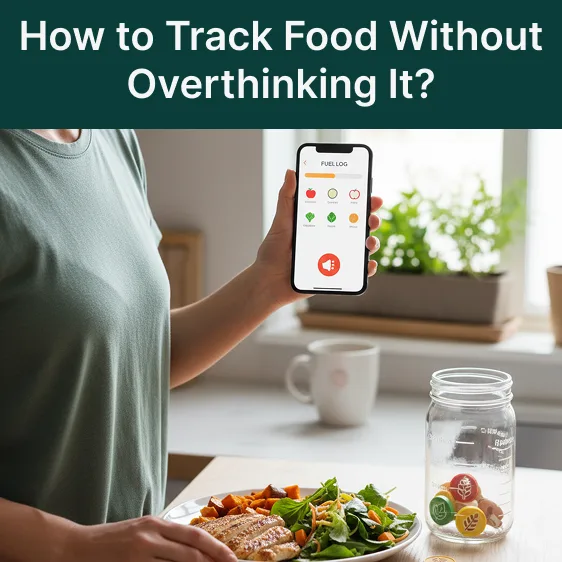
Food tracking can be useful.It can also become exhausting if you treat every meal like a maths exam.
The goal is not to track perfectly forever. The goal is to understand your food well enough to make better decisions.
Calories, protein, carbs, and fats are not moral scores. They are information. When you track food well, you start to see patterns:
Which meals keep you full
Where extra calories sneak in
Whether you are getting enough protein
How weekends affect your week
Which foods are worth planning around
What portions actually look like
This guide will show you how to track food without overthinking it.
Quick Answer
To track food without overthinking it, use the method that fits the meal. Use barcode logging for packaged foods, search for simple foods, photo or text logging for quick estimates, and manual ingredient logging for home-cooked meals. Focus more attention on calorie-dense foods like oil, nuts, cheese, sauces, and snacks. You do not need perfect tracking — you need a useful estimate you can repeat consistently.
First: accuracy means “useful,” not perfect
Food tracking will never be 100% exact.
Even packaged labels can vary slightly. Restaurant meals are estimates. Home-cooked meals depend on ingredient weight, oil, sauce, cooking method, and portion size.
That does not make tracking useless.
It just means your goal should be a useful range, not perfect precision.
Think of tracking like budgeting money. You may not know the exact cent, but you can still understand your spending pattern.
The five main ways to log food
Most tracking tools like Aphil Fitness use a mix of methods.
The best method depends on the meal.
1. Search logging
This is the most common method.
You type the food name into a calorie tracking app like Aphil Fitness and select the closest match.
Best for:
Common foods
Restaurant-style estimates
Simple meals
Foods without packaging
Quick logging
Examples:
“Cooked white rice”
“Paneer”
“Greek yoghurt”
“Vegetable biryani”
“Avocado toast”
Search logging is fast, but it depends on choosing a reasonable entry.
How to make search logging better?
Use specific terms where possible.
Instead of searching “rice,” search:
“Cooked white rice”
“Cooked basmati rice”
“Cooked brown rice”
Instead of “paneer curry,” search:
“Paneer curry with oil”
“Paneer tikka masala”
Or log the ingredients separately if it is homemade
Search logging is good enough for many meals, especially when the alternative is not tracking at all.
2. Barcode logging
Barcode scanning is useful for packaged foods.
You scan the barcode and the app like Aphil Fitness finds the product entry.
Best for:
Protein bars
Packaged snacks
Milk
Yoghurt
Bread
Frozen meals
Sauces
Cereal
Ready-to-eat foods
Barcode logging can save time, but always check the serving size.
The barcode may show nutrition per serving, per 100g, or per pack. If you ate half the pack, log half the pack. If you ate 73g, log 73g if the app allows it.
Watch for this
Barcode entries are not always perfect.
Check:
Calories
Protein
Serving size
Weight unit
Whether the product matches your country’s label
If the numbers look wrong, use the nutrition label instead.
3. Photo or meal scan logging
Photo logging can be helpful when speed matters.
You take a photo of your meal, and the app like Aphil Fitness estimates what is on the plate.
Best for:
Quick estimates
Mixed meals
Restaurant meals
Social meals
Times when manual logging feels too much
This method is convenient, but it is still an estimate.
A photo may identify rice, vegetables, paneer, pasta, or salad, but it may not know how much oil, butter, dressing, nuts, cheese, or sauce was used.
Use photo logging as a starting point, then adjust if needed.
Good use case
Photo scan:
“Rice bowl with tofu and vegetables.”
Manual adjustment:
“Add 1 tbsp oil or sauce.”
That small adjustment can make the estimate more realistic.
4. Text logging
Text logging is when you type a natural sentence like:
“2 eggs, 2 slices toast, 10g butter, black coffee.”
This can be faster than searching one item at a time.
Best for:
Repeated simple meals
Home meals
People who know their usual portions
Fast daily logging
Text logging works well when you include quantities.
Better:
“150g cooked rice, 200g tofu, 10ml olive oil, 100g capsicum.”
Less useful:
“Rice with tofu.”
The more specific your text, the better the estimate.
5. Manual ingredient logging
This is the most accurate method for home-cooked meals.
You log the ingredients one by one, then divide by the number of servings.
Best for:
Meal prep
Curries
Pasta dishes
Stir-fries
Homemade snacks
Recipes you repeat often
Example:
400g paneer
300g capsicum
150g onion
20ml olive oil
200g cooked rice
If the dish serves 2, divide the total by 2.
This method takes more effort upfront, but it gets faster when you save meals or recipes.
Which method should you use?
Use this simple rule:
Situation | Best logging method |
|---|---|
Packaged food | Barcode |
Simple common food | Search |
Home-cooked recipe | Manual ingredients |
Restaurant meal | Search or photo estimate |
Busy day | Text or photo |
Meal you eat often | Saved meal/template |
Calorie-dense ingredient | Weigh or measure |
You do not need one perfect method.
You need the method that fits the meal.
What should you measure carefully?
You do not need to weigh lettuce forever.
But a few foods are worth measuring more carefully because small changes can add a lot of calories.
Measure these when possible:
Oil
Ghee
Butter
Cheese
Peanut butter
Nuts and seeds
Sauces
Salad dressings
Rice
Pasta
Granola
Snacks eaten from a large bag
These foods are not “bad.” They are just easy to underestimate.
For example, 5ml oil and 20ml oil look similar in a pan, but the calories are very different.
What can you estimate more casually?
You can usually be more relaxed with:
Leafy vegetables
Cucumber
Tomato
Mushrooms
Herbs
Spices
Black coffee
Unsweetened tea
Low-calorie sauces used in small amounts
These can still be logged, but they are rarely the reason your weekly calories are far off.
The 80/20 food tracking system
If you want tracking without overthinking, use this approach:
Track protein consistently
Protein is important for fullness, muscle retention, and structure.
Track calorie-dense foods carefully
Oil, nuts, cheese, dressings, snacks, and desserts deserve more attention.
Estimate vegetables and low-calorie items
Do not let tiny details stop you from logging the meal.
Save your repeat meals
If you eat the same breakfast or lunch often, save it.
Review weekly averages
Daily numbers are noisy. Weekly trends are more useful.
What if you eat out often?
Eating out does not make tracking impossible.
Use a range.
For restaurant meals, ask:
What is the main protein?
What is the main carb?
Is there visible oil, cream, cheese, butter, or dressing?
Is the portion small, medium, or large?
Did I eat the full plate?
Then log a reasonable estimate.
You can also add a buffer if the meal was rich.
Example:
Instead of logging “pasta — 500 calories” for a creamy restaurant pasta, it may be more realistic to log 700–900 calories depending on portion size.
This is not fear. It is calibration.
Do you need to track forever?
Not necessarily.
Some people track daily because it helps them. Others track for a few weeks to learn portions, then move to a lighter system.
Food tracking can be used in phases:
Learning phase: track more carefully
Fat loss phase: track consistently
Maintenance phase: track when needed
Busy phase: use templates and estimates
Reset phase: track for 7–14 days to recalibrate
The goal is not dependency.
The goal is awareness.
A simple beginner plan
If you are new to tracking, start here:
Week 1: Just log
Do not change anything yet. Just learn what you currently eat.
Week 2: Check protein
Look at whether you are getting enough protein across the day.
Week 3: Measure calorie-dense foods
Start measuring oil, snacks, cheese, nuts, and sauces.
Week 4: Build repeat meals
Create 3–5 meals you can reuse.
By the end of a month, you will understand your food much better without needing to obsess over every gram.
The main takeaway
Food tracking works best when it feels usable.
Search when you need speed.
Use barcodes for packaged foods.
Use photos when estimating is better than skipping.
Use text for quick logging.
Use manual ingredients for meals you cook often.
Accuracy matters, but perfection is not required.
The best food log is the one you can keep using on a real week.
FAQs
What is the easiest way to track calories?
The easiest way is to use a mix of methods. Use barcode scanning for packaged foods, search for common foods, and save meals you eat often. For home-cooked meals, logging ingredients and dividing by servings is usually more accurate.
Do I need to weigh all my food?
No. You do not need to weigh everything forever. It helps to measure calorie-dense foods like oil, butter, cheese, nuts, sauces, rice, pasta, and snacks. Lower-calorie foods like leafy vegetables, cucumber, mushrooms, and herbs can usually be estimated more casually.
Is calorie tracking always accurate?
Calorie tracking is never perfectly accurate. Labels, portions, cooking methods, and restaurant meals can all vary. The goal is not perfection. The goal is a useful range that helps you understand your food and make better decisions.
How do I track homemade meals?
Log the main ingredients, add the total calories and protein, then divide by the number of servings. If you cook the meal often, save it as a repeat meal so you do not have to rebuild it every time.
How do I track restaurant meals?
Use a reasonable estimate. Look at the main protein, carb, visible oil, sauce, cheese, dressing, and portion size. If the meal is rich or oily, add a small buffer instead of choosing the lowest possible estimate.
Can I lose weight without tracking every day?
Yes. Some people track daily, while others track in phases. You can track for a few weeks to learn portions, use saved meals, or return to tracking when your routine needs recalibration. The best system is the one you can keep using.